Wednesday, August 4, 2010

Heri

Photo: Prayer flags between Heri and the nearby Terton Chogar Gompa Monastery (August, 2010).

Yaks, dri, sheep, goats, horses, and Tibetan tents were scattered and clustered across the seemingly boundless rolling steppe. At one tent, a boy ran to our stopped bus with a large plastic tank. The driver took the tank and poured the diesel fuel into the bus. From a stream, a woman brought another plastic container before the driver filled a makeshift tank behind his seat. Meanwhile, the road, like so many of China's stimulated cities and villages, was under frantic construction.

"It looks like the Chinese are rushing to get the road done before winter," I said to Sander.

"It looks like they're racing to get it done by next week," he replied.

By early evening we had traveled from Zeku to Heri (pronounced, "Hor").

Heri was a small village. Outside the bus we were pointed to the guesthouse where we immediately booked a room upstairs over a shop. There would only be electricity during certain hours. There was no running water during any hours. When I asked about the toilet, we were directed to the community facility down the road.

Heri was a small but vibrant village. We thought it was awesome!

Photo: The wall at the head of my bed (August, 2010).

Photo: The bed post on which I cut my foot during the night (August, 2010).

Populated with Tibetans and Hui, Heri functioned as a center for buying supplies as well as for trading horses, sheepskins, and so on. At times, like in the late mornings or late afternoons, it seemed the population swelled to 10 times its normal size with people in from the steppe. But around noon, when the day was hot, most people were napping. Sander and I didn't nap. We had too much to do.

Photo: Stupas at the Terton Chogar Gompa Monastery (August, 2010).

Photo: Sander at the top of the hill at the Terton Chogar Gompa Monastery (August, 2010).
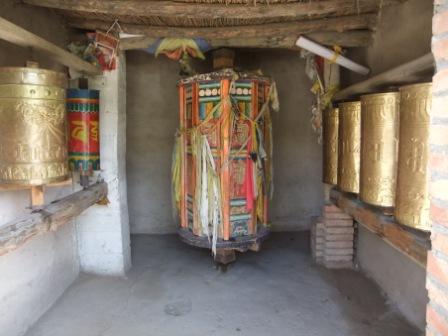
Photo: Prayer wheels at the Terton Chogar Gompa Monastery (August, 2010).

Photo: A monk, a fire, and Sander reloading at the Terton Chogar Gompa Monastery (August, 2010).

Photo: Mani wall at the Terton Chogar Gompa Monastery (August, 2010).

Photo: Yak dung ceremonial fire at the Terton Chogar Gompa Monastery (August, 2010).
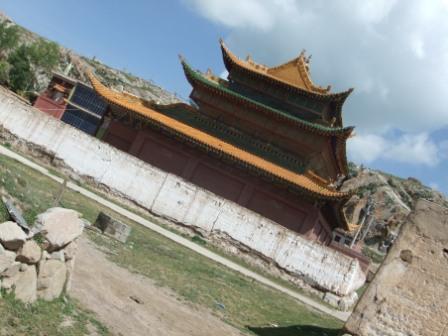
Photo: Near the center of the Terton Chogar Gompa Monastery (August, 2010).

We walked a kilometer up the road, passing, and getting passed by, a herd of sheep and another herd of yaks, to a brilliant stand of prayer flags. We filmed and took photos before continuing up the road to a monestary called Terton Chogar Gompa. There was no charge to get in, we discovered, as we hiked up a hill into the monestary in a clockwise direction where they gave us vitamin water and candy. From the top of the hill the view over the valley was incredible! We walked by a long wall of mani stones and descended on the other side taking lots of photos of prayer wheels. Before long, we seemed to be getting into the heart of the facility when we heard the faint sound of drumming. We followed the drums!

Photo: The building we entered to view drumming and chanting at the Terton Chogar Gompa Monastery (August, 2010).

They led us to a doorway in a walled compound. The beating was coming from inside. From a multi-storied building constructed in a traditional Tibetan style. There was a monk at the wall's entrance. I asked if we could go watch. Surprised to see foreigners, he said we could. Sander and I looked at each other equally surprised at this opportunity. I asked the monk if we could take photographs. He agreed we could. Sander and I looked at each other again, smiled, then stepped through the entrance.

Photo: An inner-sanctum ceremony of chanting and drumming at the Terton Chogar Gompa Monastery (August, 2010).

Sander began filming immediately. He caught the audio of the drumming on his approach. As we ascended stairs, we could soon hear chanting. Sander kept the camera rolling. We entered the building and saw shoes and sandles near the entrance. So we took ours off and I took off my hat as well. We walked quietly up to another entrance and sat down. Two inner and two outer rows of monks, some old, others quite young and sitting on laps. Two drums. Some of the monks looked uncomfortable with our filming. They seemed self-conscious. Yet others didn't mind. The room was a brilliant red with gold throughout. It looked, well, amazing. They continued to drum. They chanted. The chants changed in rythym over time. One monk walked by spreading smoke from incense. It was a fascinating ceremony and the generosity we experienced at the monestary gave me a different perspective from other monks we saw eating from huge cauldrons or buzzing by on new motorcycles or drving in BMW's.

We spent two wonderful, if not spartan, days in Heri before moving on by taxi to Tongde.

Photo: Prayer flags spanning a river between the village of Heri and the monastery of Terton Chogar Gompa (August, 2010).

Photo: Sander filming at the Terton Chogar Gompa (August, 2010).

Photo: Stand of prayer flags between Heri and Terton Chogar Gompa (August, 2010).

Tuesday, August 3, 2010

Brief Update from The Girls in VT

Thanks to all who have written to Daryl and Courtenay back home in Vermont!

Sander is feeling much better. His fever broke and he was fine as of yesterday when we last heard from Brad. The "boys" have moved on to Zeku, I believe. We should hear more shortly!

xo,
Daryl

Monday, August 2, 2010

Zeku

Photo: Horse-trading, or a festival before a race, #1 Zeku (July, 2010).

Photo: Horse-trading, or a festival before a race, #2 Zeku (July, 2010).

Photo: Horse-trading, or a festival before a race, #3 Zeku (July, 2010).

Photo: Horse-trading, or a festival before a race, #4 Zeku (July, 2010).

Photo: Horse-trading, or a festival before a race, #5 Zeku (July, 2010).

Photo: Sander getting dropped off in Zeku (August, 2010).

Sander and I loved Henan. Only later did we realize that most of the people we thought were Tibetan were actually Mongolians who had, over time, adopted many Tibetan ways, making them difficult to tell apart. I will not claim to be able to make the distinction between Amdo Mongolians and Amdo Tibetans in the Mongolian county of Henan. But we loved Henan. In Henan, after a long and arduous journey getting there, we were finally able to relax in a fascinating and diverse atmosphere. We were hungry for diversity. But after ten days in Henan we hopped on a bus for Zeku.

Photo: Binguan night lights in Zeku (August, 2010).

Zeku is a Tibetan town about an hour's drive northwest from Henan. In Zeku, just beyond the yaks on the road, Sander and I were the only two to get off the bus. It was hot, dry, dusty. We threw on our backpacks as the bus took off for Xining, and headed into town. We passed two horses hitched to a post. All that was missing were bouncing tumbleweeds.

Photo: Binguan (guesthouse) in Zeku where we stayed (August, 2010).

Both of us were looking for the Chinese characters for binguan, which means "guesthouse", which means "cheap hotel". We didn't see any for the longest time. But when we stopped to rest and ask for directions, the door we stepped through was an internet cafe. The woman running the place pointed across the street. Down the side alley, now blantantly obvious, were four binguans. We took the first.

Typical of China, the rooms were simple: two beds with thick quilts and flat pillows, a TV (maybe it worked, maybe it didn't), two chairs, a tea table, a night stand, a light in the ceiling, and a little coal stove. There was a community toilet outside and a community washroom down the hall. It had running water: it ran out a spout from a hanging bucket. It was cool. We liked this place, but elected to stay two nights instead of four.

Zeku, like the rest of the China we've seen, appeared to have received an enormous stimulus package from the government and put many people to work. It has been transforming towns like this, as well as the country as a whole, resulting in what appears to be an economic boom of sorts. It's amazing! But staying in Zeku at this time was like living inside a construction site. In Henan, the construction was taking place on the outskirts of town, so we were able to relax. But in Zeku, construction was taking place outside and inside. It wasn't fun, mainly, I think, because the first eight days of our journey was so intense it was like traveling inside one of these hurried Chinese construction sites. We needed to get away from that. From this.

Photo: Herding young yaks into a police blockade, Zeku (August, 2010).

Nevertheless, after settling in and eating lunch at a Hui restaurant, we headed out to explore the town. It was construction all over. But at the west end of town was a hill covered in prayer flags. They were prayer flags like we've never seen. Some were like a 100 feet long! We photographed and filmed like crazy. On the far side of the hill the steppe opened up to clusters of tents, and herds of yaks, horses, and sheep. Sander and I sat and enjoyed the view. The grasslands, the mountains, the clans herding hundreds and hundreds of animals over miles and miles. Gorgeous!

Photo: Sander turning a huge prayer-wheel near the mound of Tar-choks in Zeku (August, 2010).

Photo: Scene and yak-dung mound at the Tar-choks, Zeku (August, 2010).

Photo: Stupa at the Tar-choks, Zeku (August, 2010).

Photo: Detail of the Tar-choks in Zeku (August, 2010).

Photo: Woman walking clockwise around Zeku Tarchoks and the girls who flirted with Sander (August, 2010).

The next day after eating breakfast in our room, I went back out onto the street only to discover that, contrary to the guidebooks I'd brought, there were no longer any busses to Tongde, the next town on our planned journey. Were we unable to get to Tongde, we might have to return to Xining the way we came. We didn't want that. I asked around. Eventually, I was told by a bank officer that we could take a bus to Heri (pronounced "Hor"). Heri was about 41 kilometers from Tongde. Given the efficiency of the Chinese transportation system, we figured that there must be a bus from Heri to Tongde. An unreliable source confirmed that there was indeed a bus. I told Sander. He said, "Let's go for it!" I told him that I was told that the bus will be out here at 10:00 am. We packed and checked out.

Photo: Zeku street scene (August, 2010).

The bank officer walked us to the bus and introduced us to the driver. Because no tickets were being sold and payment was only being accepted right before departure, no seats were claimed until then. But the bus would not be leaving until 2:20 pm. So Sander and I dropped our packs and were about to settle in for a long wait. The driver suggested we place our packs on the seats and he would watch them. We did and decided to go journal in a restaurant. But half an hour later, Sander noticed that the bus wasn't there. Our hearts raced. But this sort of thing often happens in China. The driver told us where he would be departing from. So we went to look for him and sure enough, there he was.

Photo: Tents and herds of yaks, horses, and sheep on the edge of town.

But this was a strange day. The police, for reasons I never understood, blocked off the entire intersection at the center of town for hundreds of yards and for hours. At times it was funny watching them and the herders trying to control unruly yaks that didn't understand they couldn't pass through. Then the police kept moving the parked traffic around. This meant that Sander and I spent the day tracking and retracking down the bus. In the end, however, we found the bus for the fourth time and loaded in, in front of our packs, with half a dozen Tibetans. The bank officer came to make sure we made it onto the bus. After the bus spent another 30 minutes driving around looking for more passengers, we were off across the steppe once again west for Heri.

Photo: Our bus to Heri (August, 2010).

Saturday, July 31, 2010

Mongolian Flies

Photo: Sander sleeping in bed, Henan Mongol Autonomous County (August, 2010).

When I got sick in Xining, Sander took care of me.

Now Sander is sick. Really sick. Far worse than I was. I bought a thermometer and took his temperature. He has a fever. He's really in bad shape. I'll save him the embarrassement and won't describe it. In case his condition worsens, I scoped out the hospital. It's down the street. It closes at 5:30 pm. They seemed like good people. Meanwhile, Sander is taking his Ciprofloxicin, and he's sleeping.

Because the hotel's, and maybe this part of town's, water supply shuts down for hours daily, I only left Sander to make three water runs and pick up supplies. Otherwise, I'm just laying here as Sander sleeps. I wake him up periodically to get him to drink the oral rehydration solutions I mixed up with bottled water, salt and sugar. He did this for me in Xining. (Although he recently admitted that he mixed up the sugar and salt amounts. It tasted like saltwater, but I drank it anyway.) Meanwhile, things are quiet. I hear Sander breathing. Good.

I'm caught up with my journal.

I'm not in the mood to read.

I watch the flies.

The flies.

We have three or four types of flies in our room. Their numbers have been reduced, however. I bought a swater today on a water run. I had to. When I woke up and saw six flies on Sander's heavy thick white quilt, I found the site disturbing. I've been getting Genghis on the flies. Not all the flies. I'm selective with my wrath.

The first type of flies are the ones Sander noticed and wrote a humorous piece in his journal about. He named them Mongolian flies. I look forward to what he says on his blog when he writes about them. We've never seen anything like them. They hover in a self-selcted imaginary sphere in the three-dimensional center of our room and dance. It's fly ballet. Elegant. Beautiful. Inspiring. They interact mostly with themselves. They glide and dart but only within that imaginary sphere. They leave us alone. They leave our food alone. The only things they don't leave alone is the second type of fly.

I call these the bumble-flies. They are huge, fat, obnoxious, clumsy, juicey, and loud. They arrive one at a time. When one comes near the Mongolian flies, they attack. The bumbles bumble away and bounce off the wall. Sometimes they hit my head with a thud. I splatter the bumbles with my swatter. They explode. This leaves me with a mess to clean up. But I'm glad to do it. I hate bumbles in our room. All flies have easy access to our room because there is no screen on our window. Our room would be impossible during the day with the window shut, so we keep the window open. We open an invitation to flies of all sorts. They like to visit. We provide good things to eat. Our room fills with flies.

The third type of fly is the common house fly. Unlike the unnerving buzz of the bumbles, the houseflies fly silently. Stealthfully. They land on our faces in the early morning and wake us up. I hate waking up to houseflies. I cringe at the site of them on Sander. I wonder if they landed on garbage and then on our spoons, chopsticks, mugs and glasses. Maybe they contributed to Sander getting sick. I grab the swatter. I go Genghis. Carcasses are bestrewn across the floor. Legs are still sticking to the walls. I put a sign outside our window. It has a crushed fly...and says: ENTER AT YOUR OWN RISK.

There might be a forth type of fly. It's narrow. It bites. It reminds me of those biting flies on the beach of the American eastern seaboard. But I could be wrong. I need more data.

I could say that I'm sick of flies, but that would be a gross generalization. I love Sander's dancing Mongolian flies. They're welcome anytime.

Photo: Dead flies, Henan Mongol Autonomous County (August, 2010).

Arrival in Henan Mongol Autonomous County

Photo: Manager of the hotel in which we spent most of our nights in Henan Mongol Autonomous County (August, 2010).

28 July 2010

Sander and I have to make our money last. We have no choice but to make every Yuan Renminbi stretch as far as possible. We can't leave China before our flight, and don't want to leave Amdo in Greater Tibet until the last possible moment because our money goes further here. This has meant a change in lifestyle.

We can't graze through the course of a day simply because an abundance of food is available in the refridgerator or cabinets. We have no refridgerator or cabinets. Processed food in China is expensive, although there is a lot of it and it's beginning to show on the waistlines of the more affluent Chinese in the form of pounds.

Meanwhile, I'm shedding them. I eat meals and seldom anything in between. I've gotten used to being hungry. That has been a big step for me. Before this trip, at home, I never went hungry for very long. At the slightest urge, I shoveled or woofed something down. But not now. I even wake up famished because I don't eat before bed. If I'm hungry at night I drink a cup of hot water. At home, I had a couple beers.

The first day we arrived in Henan, I had a regional beer to celebrate even though I had a headache. I didn't realize that my headache was the beginning of altitude sickness. It was a mistake drinking the beer with altitude sickness. I haven't had a drink since and feel no need to. It's odd, but I feel better, thinner, healthier, than ever. I would like to think that I'm acquiring a heightened sense of discipline, but it's really a matter of necessity to stretch our money. The true test will be after we return home and I have food all around me 24 hours a day. But for now, this lifestyle has been good for my wallet and waisteline.

Sander, on the other hand, I try to keep well fed at all times. He doesn't need to lose weight. But he doesn't have the option, like the yaks and dri around us, to graze through the course of the day. So Sander might be losing a little weight too. I hope not. But as Big Tiger and Christian often say in Muhlenweg's book about their adventures in Mongolia, "It can't be helped."

Notes from a Traveler: Guidebooks to Amdo

For anyone interested in low-budget travel to Amdo, the cheapest route is not always the cheapest route. To do over, I would not book the cheapest flight to Hong Kong and enter Mainland China through Guangzhou. Southeast China is expensive. Travel in China peaks during the summer months, and not only with foreigners, but with moving migrants and students. When one considers the migrant population, Guangdong Pronvince has China's highest population. Schools usually close in July. As Sander and I discovered, the transportation system becomes strained in the summer. Seats of any kind can be hard to come by. If one can't find a seat then one is stuck, and to be stuck in southeast China is to shell out a lot of money. It got so bad for us that I feared we might not get to Amdo, Qinghai Province, at all.

To do over, I would fly directly and non-stop to Beijing before catching another flight to Xining, Qinghai. This will be quicker, less strenuous, and, in the end, possibly cheaper.

Xining is different world. Prices are lower and get lower the farther one travels into the countryside. The countryside, the great steppes of Qinghai, are worth traveling to. Really, they are amazing! After Sander and I return home to the States I will begin posting photos. Then you can see for yourself.

As far as guidebooks, I brought a small library. I did so because knowledge is power, it can save money, and I wanted to provide Sander with the best experience and education possible. But the books are heavy. Presently, my Chinese is good enough that I could do away with all of them. Nevertheless, they have served as valuable resources. I brought four books. They are as follows:

1) Footprint: Tibet Handbook, 4th Edition, September 2009, by Gyume Dorjie. This is an amazing, informative, well-done book. Anyone traveling anywhere in Greater Tibet would be better off with it. I think it's fantastic!

2) Mapping the Tibetan World, 2000/2004 Reprint, by Osada, Allwrite, & Kanamaru. I love maps and therefore this book even though it is outdated. Nevertheless, it remains a valuable resource.

3) The Rough Guide to China, April 2008. Like maps, guidebooks are outdated as soon as they are printed. Especiially guidebooks on China because China is changing that fast! So it is with Rough Guide to China. But it has been useful. It is packed with loads of information. It is, indeed, a worthwhile puchase and useful tool. I'd always been a fan of The Lonely Planet Series but heard that Lonely Planet was going more middle-class and that Rough Guide was better serving the budget traveler. I don't know. I do know that I was often frustrated with Rough Guide to China.

One reason for my frustration has been the maps. The maps included in Rough Guide to China assume a Republic of China political perspective and not a People's Republic of China one. The maps show Taiwan as a separate nation. Regardless of one's political views, what this does is that it not only risks offending the people of the host country, but it puts the low-budget traveler at risk of having his book (his resource to low-budget travel) confiscated. That would be inconvenient and costly. I'm fine with taking political stances, but we should start at home with: independence for, and returning lands to, all of America's Indigenous Peoples; returning lands to Mexico; forming a new nation-state along America's southeast seaboard and calling it, I don't know, Africa America, and so on, and so on (to say nothing of having these forts around the world). Or we could look at Taiwan and how the government has dealt with its own indigenous population. Putting the low-budget traveler at risk of losing her/his book, and offending one's hosts, are not good ways to begin a journey.

A second reason is the spelling of the place names. It would have been useful to include the pinyin, the tones over the romanization of the Chinese characters, whenever a Chinese place was named. Granted, this was done in colored blocks in the chapters, but the way I used the book I didn't discover this until I realized I didn't need the book anymore. To use the book with the Chinese interpretations, such as finding a hotel and using the book to ask directions, one had to constantly flip back and forth between pages. If one didn't do this, then one was left with the name, for example, of a hotel without the tones or characters. In China, this is dangerous.

For example, when we hosted a Chinese exchange student and I would practice reading narratives in traditional Chinese characters, and she would correct my pronunciation, I once read the character for gan. But gan has four or five tones and each tone means something different. The gan I said was not the gan I meant. The gan I said was, "f**k". Another example: In China, the softdrink, Sprite, is popular especially among foreign travelers. Sometimes the more adventurous foreign travelers ask for Sprite in Chinese. But the second character for the Chinese word for Sprite is bi. Bi, like gan, has different tones and therefore different meanings. A Chinese tour guide once informed me of the frequency in which foreigners ask for Sprite in Chinese but since they don't get the tone right what they end up asking for is some form of vagina. It might be wet vagina, or watery vagina, but a vagina nonetheless. This cannot be found on the menus in Chinese restaurants. Tones matter. Rough Guide to China could to better with the tones and character throughout. To do over, I'd give Lonely Planet: China another chance.

4) Lonely Planet: Mandarin, 6th Edition, September 2006. At this point in our travels and limited language abilities, this is the only book I need to travel through China. Whether one only uses this, or with an actual guidebook, this is a wonderful, useful, light, small, efficient, useful book and I highly recommend it. My only complaint is that the pinyin tones and the Chinese characters are so small that I can hardly make them out, sometimes even with my glasses. Still, it's a wonderful little book!

Friday, July 30, 2010

Henan: Men with Beads

Attaining a portrait of a community is not easy work. Photographing the landscape and streetscape absent of people has its challenges.

Photo: Grasses and flowers of Amdo's rolling steppe (August, 2010).

Photo: Necklaces and prayer beads of a Henan Mongol Autonomous County shop (August, 2010).

Photo: Bundles of prayer flags in a Henan Mongol Autonomous County shop (August, 2010).

Photo: Bells for sheep and goats in a market stall (August, 2010).


However, photographing the people can be another matter altogether. This blog entry is about a process of, an exercise in, building relationships with others:


In an effort to come to grips with our own experience in the landscape and culture we find ourselves, Sander and I have been writing about, filming, and photographing the land and people around us. This has been, in part, our way of documenting the land that has shaped the people; the people, the land. Both have certainly been shaping us. I'm not sure what or whom we have been shaping. But both sides usually come away with something. Sander and I are trying to come away from this experience with as much as possible.

But one cannot just go around filming and photographing people here. Don't try this on the Hui. The Tibetan women, weighted down in colors, silver belts, and jewelry, will not allow it. And I wouldn't again risk it on a Tibetan man wearing a short sword or long knife. (I found out the hard way a couple decades ago when, after pressing the shutter button, a Tibetan pulled out a long knife and lunged after me). So Sander and I ask before we shoot and have meanwhile been trying to break down barriers. Create a sense of trust. Exposing ourselves to show that we're not bad people and hoping that maybe some will allow us to photograph them. There is so much to photograph and film here and we feel we have done so little.

Photo: Peace sign ... usually always displayed backwards (August, 2010).

Our latest attempt to endear ourselves was to sit out in a public space and draw people and things within our line of sight. In China, anything that happens in the street is fair game to watch. It is public theater. It might be an argument, a fight, a stabbing, an accident, or an actual performance...say, with a monkey. I've seen all these things. But over the past couple of days, Sander and I performed. We staged our own theater.

We sat ourselves down on a set of concrete steps outside a store on Tumotenanlu Street in Henan, and drew. We knew what would happen. It did. Within minutes we had a crowd around us so thick that not only were we unable to see each other but the motocycles we were drawing. Tibetan herdsmen love their motocycles, which they call moto. We quickly had a crowd of Tibetans, many were herdsmen.

The men who ride these motocyles dress them up colorfully and elaborately with sheepskins, saddleblankets, saddlebags, and other things. The are, in effect, modern horses. The men, meanwhile, wear chubas (the traditional Tibetan tunic) with sleeves tied in front, or in the back when it's warm above the sash, and sometimes a sword. But in the mornings and evenings their arms are in their sleeves because it gets cold quickly on the Qinghai-Tibetan Plateau when the sun isn't up.

As we drew, they were also facinated with the hair on our legs. I'd read once that the Chinese look at such characteristics as ones that place certain people closer to apes on the evolutionary scale of things. I don't know what the Tibetans surrounding us felt. But they did appreciate our efforts at drawing and loved watching. One man pretended like he was going to pull the hair from my legs. I pretended like I was going to pull the hair from his chin. He flinched, then laughed.

It was fun drawing even if Sander had to draw the moto from memory because of the crowd and I had to keep shooing people away. Some shooed still others away for me. They loved the diversion and were wonderfully encouraging to both of us.

A little girl nearby laughed at my toes in my sandles. When I wiggled my toes, she laughed. I kept wiggling. She kept laughing. Sander and I tried to draw her too but she kept moving. Finally, I took a photo of her and when she ran off I drew her from the image on my camera. The Tibetans loved that! When I got up to try to capture all the people crowded around Sander most ran off. I took a shot at those who remained.

A couple of the young, virile, males permitted me, finally, to take their photos. The one on his moto invited us to his home. He said his home was south of town out in the steppe. Because I have concerns as a father with Sander riding on a moto behind a young virile male who might have a tendency to show off, to say of the other dangers, I pretended to not understand. He told me in Chinese that he would be back for me and took off with his friend on the back of his moto. The scenario I saw playing out was: both of them soon returning each on his own bike looking to give Sander and I rides out to their homes. I told Sander. Wanting to save our Tibetan friends a sense of face (by not having to turn down their public invitations directly) and uphold my fatherly sense of responsibility, we packed it up and headed for a restaurant on another street. We saw our Tibetan friends roar by a couple times on their motos looking for us. We heard them roaring through the streets many times through the night.

But during the day we were able to form the relationships needed to photograph the portraits of many. One thing we discovered during our time in Henan was how the young males can be described as men with swords and the older ones as men with beads.

The following is a series of photos of community elders, many with prayer beads:


Photo: A prayer wheel held and spun by one of the community elders (August, 2010).:

Photo: Furniture builder (August, 2010).

Photo: Furniture carver (August, 2010).